Midwest Multifamily Private Equity

Investing Ahead of the Curve in
America's Most Overlooked Market

Gray Capital is a vertically integrated private equity firm managing over $1 billion in multifamily assets across the Midwest — one of the most overlooked, least-competitively-supplied and growing investment markets in the country.

Review current deals, broker guidance versus our pricing, and the market coverage behind Gray Capital's deal pipeline intelligence.

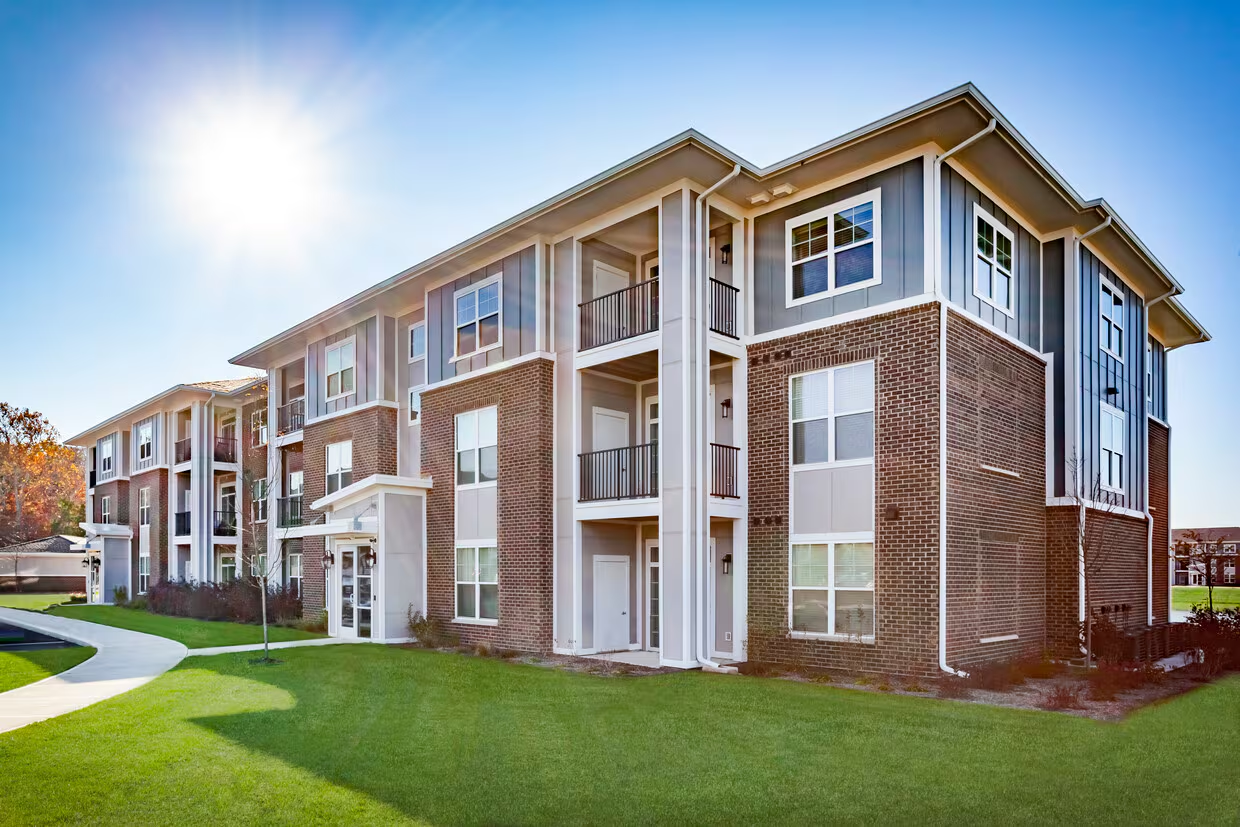
Flats at Stones Crossing — Acquired 2025
$1B+
Assets Under Management
Midwest Multifamily
29%
Avg. Investor IRR
Historical Track Record
15–20%
GP Co-Investment
Largest Equity Investor
$45–100M
Target Deal Size
~250 Units

A Market at an
Inflection Point

The national multifamily market is emerging from the most significant construction wave in modern history. In 2023 and 2024, more than 500,000 new apartment units were delivered annually — pressuring rents across most U.S. markets, particularly the Sun Belt. But that supply wave is ending. Construction starts have fallen more than 40% from their 2022 peak, and deliveries dropped 24% in 2025. The pipeline is clearing — and with it, the fundamental setup for rent growth recovery is materializing.

2026
1.5 – 2.0%
Supply wave tail end; occupancy stabilizing
2027
2.5 – 3.0%
Pipeline thinning; Midwest outperforms
2028+
3.5 – 5.0%
Historical normalization post-supply-cycle

Gray Capital's conservative underwriting assumptions. National Apartment Association projects Midwest rent growth of 3.0%–4.5% for 2026, representing meaningful upside to our base case.

The Midwest Renaissance:
A Structural Shift, Not a Trend

For decades, the region was overlooked by institutional capital as "flyover country." That perception is changing — driven by advanced manufacturing, demographic migration, supply discipline, and the early innings of institutional discovery.

01

Advanced Manufacturing & Reshoring

The CHIPS Act, Inflation Reduction Act, and broader reshoring of domestic supply chains have directed hundreds of billions into the Midwest. Intel's $28B+ semiconductor campus in New Albany, Ohio — part of its $7.86 billion CHIPS Act award — is expected to create 3,000+ permanent jobs. Honda and LG's $4.4B EV battery plant in Fayette County, Ohio, and hyperscale data center investments from Amazon, Microsoft, Google, and Meta across Indiana are transforming the regional economy.
Indianapolis employment growth: 11.6% · Columbus: 11.4% — among top Midwest metros (JLL Research)
02

Demographic Migration & Affordability

Households are migrating to the Midwest for affordability, quality of life, and economic opportunity. Mortgage payments now run 35% higher than average apartment rents nationally, structurally locking more Americans into the renter pool. The Midwest offers the best rent-to-income ratios and lower tax burdens of any region.
PwC/ULI identifies Columbus, Indianapolis, and Kansas City as top-performing emerging markets for 2026
03

Supply Discipline & Low Volatility

Unlike the Sun Belt, the Midwest never experienced speculative overbuilding. Q3 2025 deliveries were the lowest relative to their own decade-average in the region's recorded history. This translates into more predictable rent rolls, lower concession burn, and meaningfully lower insurance cost inflation.
Columbus: 3.5% rent growth · Chicago: 3.7% — even during the national trough of 2025 (Yardi Matrix)
04

The Institutional Discovery Premium

Indianapolis has historically had almost no institutional multifamily capital presence. As Midwest fundamentals attract institutional allocators — particularly those burned by Sun Belt overexposure — markets like Indianapolis and Columbus are likely to experience cap rate compression independent of rate movements.
This is not baked into our underwriting. It is upside.

See current deals and pricing discipline.

Access current deals, broker guidance versus our pricing, and market coverage across the regions where we have deep local intelligence.

Access current deals, pricing discipline, and market coverage.

Review our live deal pipeline, broker guidance versus our pricing, and the market intelligence behind every opportunity we evaluate.

Your information is submitted securely to Gray Capital via HubSpot. We will not share your data with third parties.

Investment Strategy:
Actuals Over Proforma

We acquire Class A and B multifamily properties across Indiana, Ohio, Kentucky, and Michigan — all within driving distance of our Indianapolis headquarters. Our target markets share a consistent profile: area median income near or above $100,000, strong school districts, and sustained economic momentum.

150–450
Unit Count
$25–100M
Purchase Price
90%+
Min. Occupancy
$100K+
Target AMI
Strategy I

Core-Plus

Class A acquisitions in high-barrier submarkets where the primary value driver is market rent recovery, operational outperformance, amenity upgrades and capital preservation. Minimal physical intervention required.
Strategy II

Light Value-Add

Targeted capital improvements — clubhouse refreshes, unit upgrades in select tranches — in Class B assets where existing rents are below achievable market and management has been undercapitalized.
Strategy III

Heavy Value-Add

Comprehensive repositioning where price reflects significant deferred maintenance or management underperformance. Reserved for situations where return premiums are acceptable and the operational path is clearly defined.

Flats at Stones Crossing

292 Units · Class A · Greenwood, IN · Acquired October 2025
Flats at Stones Crossing, a 292-unit Class A multifamily community in Greenwood, Indiana
$66M Purchase Price
292 Units
Built 2024
Monthly Distributions
96.2%
Occupancy
+12.9%
NOI vs. Budget
8.0%
Renewal Growth
6.0%
Ann. Distribution

In its fourth full month of operations, Flats outperformed across every key metric — revenue exceeded budget by 2.0%, operating expenses came in 14.1% below plan, and Net Operating Income of $318,273 beat underwriting by $36,430. Centralized leasing and disciplined expense management drove the variance, validating the operational model we apply across the portfolio.

As of January 2026

Return Targets &
LP Structure

Gray Capital structures investments as 506(c) Regulation D syndications, with the GP co-investing 15–20% of total equity — making us consistently the single largest investor in each deal. We believe this alignment is the most important signal of our conviction.

Return Targets & LP Economics
This information is intended for accredited investors as defined under Regulation D of the Securities Act of 1933.
By clicking, you confirm you meet the SEC's definition of an accredited investor.

Built by Operators,
Not Just Allocators

Gray Capital isn't a fund manager that outsources execution. We built the operating platform from scratch — and our leadership team invests alongside our LPs in every deal.

Spencer Gray
Spencer Gray
CEO & Co-Founder
Serial entrepreneur turned multifamily operator. Built Gray Capital from a single 200-unit acquisition to $1B+ AUM. Leads acquisitions, capital markets, and the firm's technology and data strategy. Hosts The Gray Report podcast.
Alex Gray
Alex Gray
Co-Founder
Oversees Gray Residential, the firm's vertically integrated property management arm. Leads operations across the portfolio — from centralized leasing to on-site facilities — managing 66+ employees across four states.
Jay Reader
Jay Reader
Chief Investment Officer
Joined as CIO in 2020. Leads underwriting, asset management, and portfolio strategy. Brings institutional rigor to Gray Capital's "actuals over proforma" investment philosophy.
Blake Pieroni
Blake Pieroni
Senior Manager, Capital Markets & Investor Relations
Your point of contact. Blake manages LP communications, capital raise coordination, and investor onboarding. Olympic gold medalist turned capital markets professional.

Our three-silo property management platform — centralized operations, regional property management, and dedicated facilities — becomes more efficient as it scales, creating a natural moat against pure-play operators in our markets.

Centralized Ops
Indianapolis HQ
Leasing, accounting, renewals, delinquency — all centralized
Property Ops
Regional Layer
Compliance, financial tracking, resource coordination
Facilities
On-Site Teams
Dedicated maintenance supervisors with facilities expertise

Why Now:
A Generational Opportunity

The confluence of suppressed NOIs, softened investor sentiment, and limited institutional capital competition has created a pricing environment where stabilized assets are available at discounts to replacement cost — levels we have not seen since pre-pandemic.

What We Underwrite
Base Case
  • 1.5–2% rent growth in 2026
  • Fixed-rate agency financing; positive leverage required
  • Conservative exit cap rates; no compression assumed
  • Strong day-one cash flow
  • 15–17% target net IRR
What Could Happen
Upside Case
  • Rent growth inflects earlier — late 2026 or early 2027
  • Rate cuts drive cap rate compression and enhanced exit values
  • Institutional discovery premium reprices Midwest cap rates
  • Gray Capital continues to find operational efficiencies with AI and technology
"
Fantastic reporting! Another syndication I'm an LP with provides a single email with a brief update. Your updates and reporting are top shelf. Thank you.
Robert McDonald
Gray Capital Investor

The Midwest has been overlooked
for too long.

Review current deals, pricing discipline, and the market coverage shaping our pipeline before you schedule time with our team.

Schedule a Conversation with Our Investor Relations Team
Gray Capital — current deals, broker guidance versus our pricing, and market coverage.
Review Deal Pipeline Intelligence Schedule a Meeting